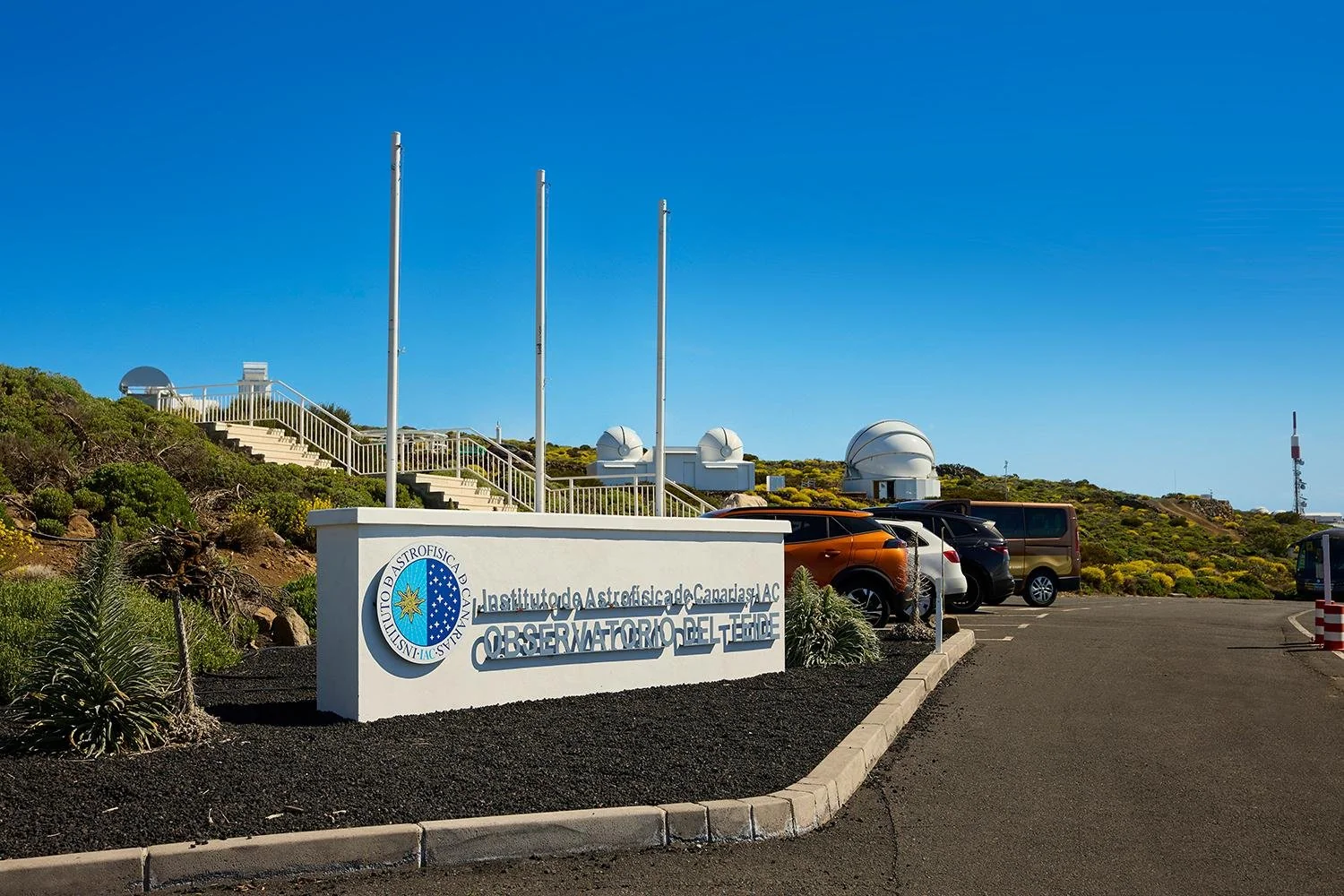
Planning Your Teide Observatory Visit
The white domes at Izaña belong to a working scientific observatory. A Teide Observatory visit is a chance to understand what its instruments do, how a guided visit unfolds and why daylight is part of the experience.
The most useful question to settle first is what you mean by visiting an observatory. Going inside the research facility, looking at the Sun through a solar telescope and joining an outdoor stargazing evening are different experiences. Knowing which one interests you makes the rest of the planning easier.
This guide focuses on the facility visit. It explains its setting and scientific purpose, then the practical details that deserve attention before you choose a tour.
What the Observatory is there to study
Teide Observatory is located at Izaña in Tenerife. The Instituto de Astrofísica de Canarias describes it as an international research observatory with instruments studying the Sun and other astronomical subjects. The buildings you see are part of that scientific work, rather than a visitor attraction designed solely for sightseeing.
Solar astronomy gives the visit a useful starting point. The Sun is a star close enough for specialist instruments to reveal details such as sunspots and solar activity. A guide helps explain why different telescopes answer different questions.
What happens on a guided facility visit
The standalone Guided Tour includes entrance, a guide, use of two solar telescopes and access to a professional night telescope. One solar telescope is used for sunspots and the other for solar flares. These are guided observations through the equipment provided for the visit.
The night telescope is there to help you understand how large research instruments work. Visiting it during the day should not be confused with looking through it at night. If nighttime observing is the experience you want, the combined Observatory and stargazing excursion continues to a separate outdoor observing location later.
Where it is, and how to arrange the journey
Teide Observatory is at Izaña, approximately 2,400 metres above sea level. For road access, the operator places the entrance at kilometre 1 of TF-514, reached from kilometre 37 of TF-24. See the official Observatory access information when planning the journey.
The IAC facility location map shows where the Observatory is. For the English daytime Guided Tour, use the tour meeting point and navigation link instead. The facility marker and the selected tour’s arrival point are different locations.
The standalone Guided Tour excludes transport, so arrange your own journey to the meeting point for your booked option. The longer Astronomical Tour includes small-group transport from an available collection point. A cable-car ticket or summit visit does not provide Observatory admission.
Choose a visit time and language
The standalone facility visit is listed as 1.5 hours. Its available guide languages include English, Spanish, German and French, but you should choose the actual language option offered for your date. Do not assume that every departure uses every language.
Visits are guided and take place in daylight. Use the booking calendar to choose a session rather than treating the Observatory as an attraction with unrestricted daily walk-in hours. If you choose the longer excursion, allow its listed eight hours and remember that pickup time changes with the season and sunset.
Consider the altitude and access before booking
Moving around the Observatory involves gravel paths, and the altitude means there is less oxygen than at sea level. The daytime Guided Tour excludes people with mobility impairments and respiratory issues. Its guidance also cautions against participation for people with general physical health problems, including anaemia, heart conditions and breathing problems.
Both featured visits exclude children under eight. Older children need a passport or ID card to confirm their age. For the extended Astronomical Tour, the operator advises people with health conditions to consult their doctor before taking part. Check the requirements for the exact excursion you choose, rather than assuming the two formats have identical rules.
Prepare for sun in the day and cold later
For the daytime Guided Tour, bring warm clothing, comfortable clothes, sunglasses and sunscreen. The high-mountain setting deserves preparation even if you leave a warm coastal resort. Bring the required identification for children.
For the combined excursion, long trousers, long sleeves and closed-toe shoes are required as well as warm clothing. Guests who do not have the required clothing cannot join. Food and drinks are excluded from that tour, so plan those before departure rather than expecting dinner to be part of the booking.
Sources
Choose the visit that fits your day
Start with the daytime tour if the Observatory is your main interest. Choose the longer excursion if you want the facility visit to be part of an afternoon and evening devoted to astronomy.
Explore Observatory tours